



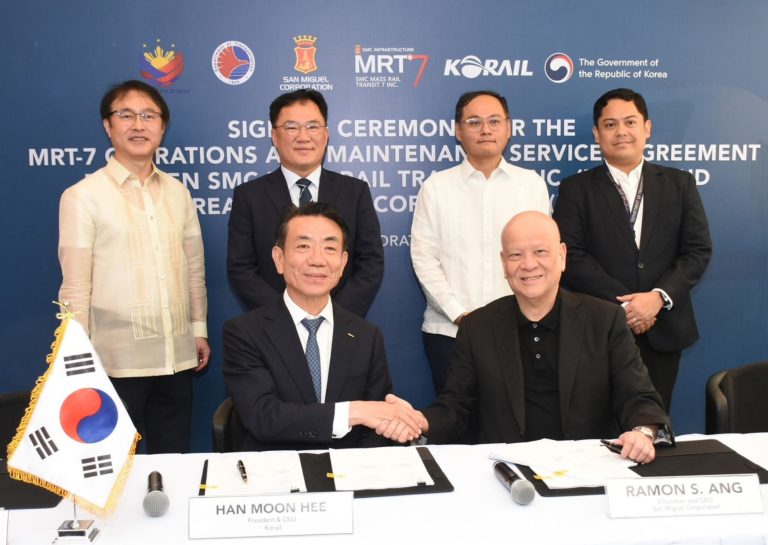
San Miguel Corporation’s infrastructure arm, through its subsidiary SMC MRT-7 Corporation, has signed an Operations and Maintenance (O&M) Services Agreement with Korea Railroad Corporation (KORAIL), South Korea’s national railway operator, as the MRT-7 project moves toward full operations.
Under the agreement, KORAIL will continue serving as technical advisor, supporting the establishment of MRT-7’s core operational systems, safety protocols, and maintenance programs. SMC MRT-7 Corporation holds the concession to build, operate, and maintain the 22-kilometer MRT-7 line, which connects North Avenue in Quezon City to San Jose del Monte, Bulacan via Commonwealth Avenue.
The ceremonial signing was attended by SMC Chairman and CEO Ramon S. Ang, KORAIL President and CEO Han Moon Hee, Vice Minister Baek Won Kug of Korea’s Ministry of Land, Infrastructure and Transport, and South Korean Ambassador to the Philippines, His Excellency Lee Sang-hwa. The Philippine Department of Transportation (DOTr) was represented by Undersecretaries Giovanni Lopez, Timothy John Batan, and Jonathan Ronulo.
Leveraging its extensive experience in operating large-scale railway systems, KORAIL will lend its technical expertise to ensure a smooth transition from construction to revenue service. The engagement begins in July 2025, with the first six to 12 months dedicated to completing pre-operational requirements and stabilizing key systems. Beyond this phase, KORAIL will continue to provide long-term technical assistance for operations and maintenance, helping ensure continuity, enable knowledge transfer, and implement global best practices throughout the MRT-7 system.
“This marks a critical step as we prepare to deliver MRT-7 to the public,” said SMC’s Ang. “Despite delays largely due to right-of-way challenges, we’ve remained committed to the project. With all train sets expected to be fully operational and tested by year-end, and full service targeted by 2026, our partnership with KORAIL moves us closer to achieving that goal.”
KORAIL operates South Korea’s vast rail system, including the high-speed KTX network, metropolitan commuter lines, and intercity services. It is internationally recognized for its strengths in railway safety, system integration, infrastructure management, and workforce training.
Ang also acknowledged the DOTr’s proactive support under the leadership of Secretary Vince Dizon, crediting their coordination across agencies as key to keeping the project on track.
“This agreement showcases the power of public-private collaboration,” Ang added. “At San Miguel, we are committed to delivering infrastructure that not only improves daily life for Filipinos but also contributes to long-term economic development.”
On behalf of the government, Secretary Dizon reaffirmed President Ferdinand Marcos Jr.’s directive to ease the burden of commuters through reliable, safe, and efficient mass transport systems.
“We are putting passengers first. Our focus is on ensuring that infrastructure and transport projects like the MRT-7 deliver safety, efficiency, comfort, and reduced travel times,” said Dizon in remarks delivered by Undersecretary Timothy John Batan.
KORAIL officials described their renewed collaboration with SMC as a “landmark of cooperation and mutual prosperity,” aimed at enabling one of the Philippines’ top corporations to thrive in the railway sector.
“I am confident that the fusion of KORAIL’s technical expertise and San Miguel’s management excellence will make MRT-7 the premier railway in the Philippines,” said KORAIL President Han.
“I believe the success of MRT-7 will serve as a benchmark for future railway projects in the country and greatly enhance mobility and quality of life for Filipinos,” he added.
Once operational, MRT-7 is expected to significantly reduce travel time, ease congestion along major road corridors, and improve connectivity across Metro Manila and neighboring provinces through its 14-station route.
